


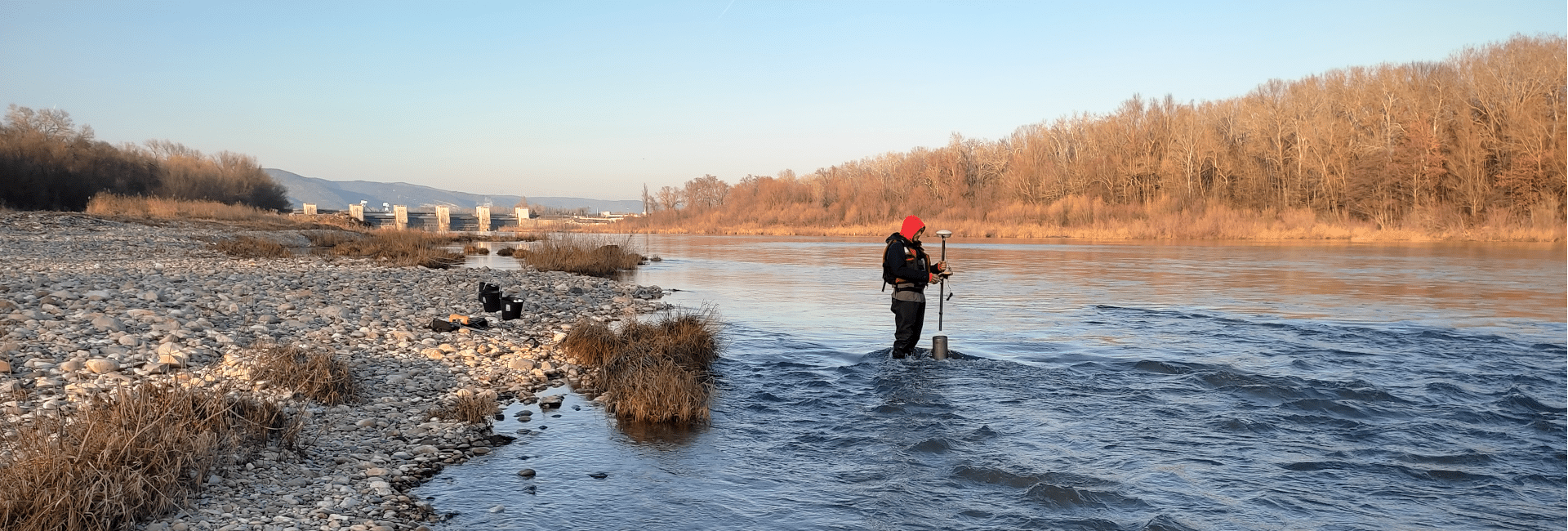
OHM Vallée du Rhône conducts research on the entire socio-ecosystem that makes up the river corridor. The research concerns the river, its banks and alluvial plain, as well as its delta. Scientific activities are carried out from Lake Geneva to the Mediterranean, sometimes along the entire 540 km length of the Rhône, sometimes more locally on sites of particular interest.
Scientists are studying how the socio-ecosystem functions and how it is changing today. At the turn of the 21st century, several major floods led those involved in the river to question a history of development dating back more than two centuries and a management principle based on hydraulic domination. The Rhône-Saône Plan, implemented in the wake of these floods, is the marker of a new form of development for the river, intended to be more integrated and sustainable. This paradigm shift, which is now being reinforced but also challenged by the urgency of the environmental transition, is the focus of the research conducted by OHM Vallée du Rhône.
Conceptual diagram structuring the activities of OHM Vallée du Rhône
Socio-ecological framework
A historic development
of the river…
For more than two centuries, the Rhône has undergone extensive development, whether to prevent flooding, enable navigation, or develop hydroelectricity. From Lake Geneva to the Mediterranean, the river, its alluvial plain, and its delta have been completely transformed by human activity.
FOUNDING EVENT
A succession
of major floods…
At the turn of the 21st century, a series of floods (1990, 1993, 2003) had a major impact on the regions around the Rhône and affected the people living along its banks. These floods altered the balance established between people and the river. They have raised awareness of the social and environmental consequences of historical developments.
FOCAL OBJECT
A paradigm shift in the management of the Rhône…
The Rhône Plan signed in 2007 is a direct response to the floods of 1990-2000. It is seen as a major change in the way the river is managed. From a sectoral approach, the players involved are now committed to an integrated approach conducive to the emergence of sustainable management of the river.
The knowledge produced contributes to a better collective understanding of the socio-ecosystemic functioning of the valley. It both questions and informs the operational implementation of sustainable river management. It addresses six major issues.
Key issues
- Understanding the river’s geo-historical trajectory and the disruptions that have marked it.
- Studying the territorial applications of sustainable development and environmental transition
- Characterizing and assessing the socio-ecosystemic functioning of the river
- Identifying and assessing environmental risks (flooding, pollution, etc.)
- Supporting ecological restoration and monitoring its effects on the river socio-ecosystem
- Developing innovative tools for understanding and sustainable management of the Rhône River.
Resources

Document
portal
Are you looking for a scientific article, research report, or oral presentation?
Access all of OHM Vallée du Rhône’s scientific publications on our Hal document portal.



GéoRhône
GéoRhône is an online mapping platform that allows users to view scientific data produced on the Rhône River.

ChronoRhône
ChronoRhône is an interactive, collaborative spatio-temporal application developed as part of the OHM Vallée du Rhône project.
It describes and locates historical events that have marked the socio-environmental evolution of the river (developments, floods, pollution, legislation, research programs, etc.).